
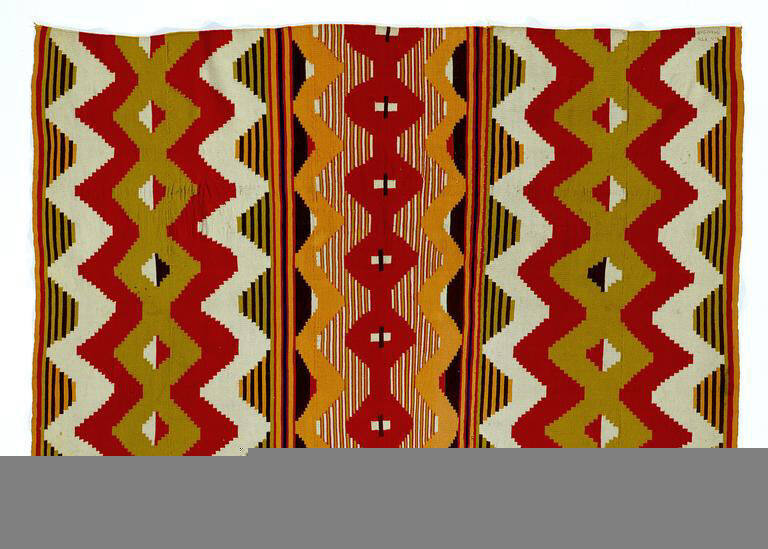

Blanket
Datec. 1870
MediumWool, commercial and homespun yarns
Dimensions76 x 52 1/2 inches (193 x 133.35 cm)
Credit LineGift of the Descendents of Helen Weeks Winchester and Captain Harrison Samual Weeks
Object number1987.93
ClassificationsTextiles
Curator NotesOblong wearing blanket made of loom-woven wool yarn (three-ply S twist) in red, white, green, orange, black, and navy. The pattern consists of serrated diamonds and zig-zag stripes arranged across the short dimension. The motifs are arranged in three broad panels, with red pendant diamonds framed by orange zig-zag stripes against a background of thin red and green stripes in the center, and panels of red-and-white or black-and-white diamonds framed by green, red, and white zig-zag stripes with green and black or orange and black triangle motifs in the interstices, on either side of the central panels. The three panels are framed by thin stripes in orange, red, and navy.
On View
On viewCollections
- Native American Minds of Colonial America Copy
Locations
- Exhibition Demo Museum (Hanover Square), Wing A, The Americas, Gallery 8
ProvenanceCollected by Harrison Samual Weeks, Captain, U.S. Army, in 1876 while stationed at Fort Union, New Mexico. Bequeathed to his daughter, Helen Weeks Winchester
Bequeathed to her children, although in the possession of Henry T. Winchester, Jr., of Allegan, Michigan
Text EntriesRelated Copy: Women's Innovation:
During the 19th Century, American Indian women artists experimented with several different media and techniques when producing objects for both their own use and for exchange or sale. The introduction of European glass "seed" beads, silk ribbon, and cotton and wool cloth contributed to innovations in the design of shoulder bags, moccasins, and other elements of clothing. Older modes of artistic expression were adapted and combined with the new, conveying the vitality and dynamism of American Indian art and culture.
From "A Visitor's Guide: The Detroit Institute of Art", p 46.
During the 19th Century, American Indian women artists experimented with several different media and techniques when producing objects for both their own use and for exchange or sale. The introduction of European glass "seed" beads, silk ribbon, and cotton and wool cloth contributed to innovations in the design of shoulder bags, moccasins, and other elements of clothing. Older modes of artistic expression were adapted and combined with the new, conveying the vitality and dynamism of American Indian art and culture.
From "A Visitor's Guide: The Detroit Institute of Art", p 46.
There are no works to discover for this record.