
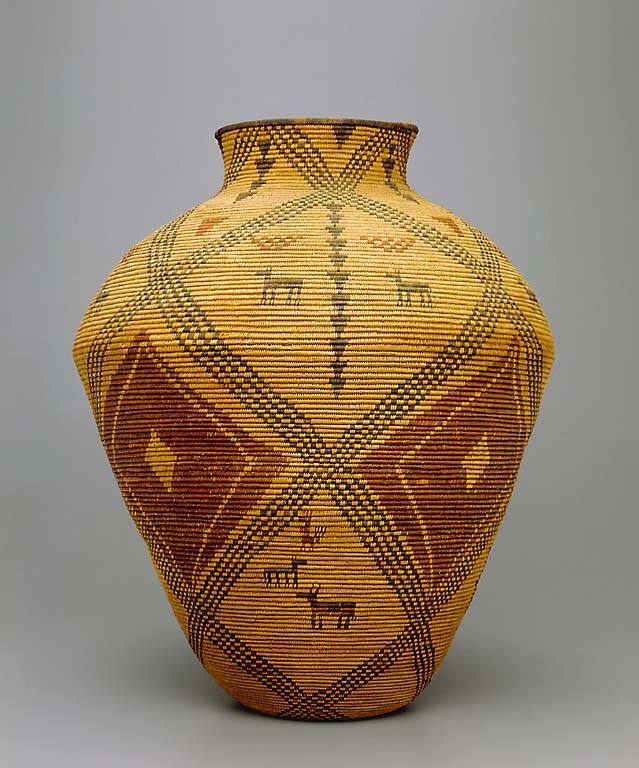

Reed Basket
Date1850-1905
MediumWillow, devil's claw, and wood
DimensionsHeight by Width: 28 inches × 18 1/2 inches (71.12 × 46.99 cm)
Credit LineFounders Society Purchase with funds from Mr. and Mrs. Peter W. Stroh and the Stroh Brewery Foundation Fund
Object number79.179
ClassificationsBaskets
Curator NotesOlla shape basket. Tapering body, wide shoulder, flaring neck. Decoration in black and red against cream ground. Large diamond shapes created by intersecting lines. Four large solid red diamonds on body with upper point touching shoulder. Animal figures and triangles in red and black scattered throughout the design.
On View
On viewCollections
- Native American Minds of Colonial America Copy
Locations
- Exhibition Demo Museum (Hanover Square), Level 1, Gallery A
ProvenancePrior to 1988, Flink Ink Corporation
Text EntriesAmerican Indian baskets were used for storage, as serving dishes, for transporting grain, wood, and water, and for ritual or ceremonial use. During the late 19th and early 20th centuries, tourists and traders began collecting baskets. The impact on this cash economy upon basket production resulted in innovations and modifications of older shapes and designs. This type of jar-shaped basket (olla) represents a new form produced specifically for sale to tourists. Skillfully decorated with animal figures and geometric motifs, this exceptionally large basket displays the compact stitching and smooth, even texture associated with Western Apache basketry.
Related Copy: Women's Innovation:
During the 19th Century, American Indian women artists experimented with several different media and techniques when producing objects for both their own use and for exchange or sale. The introduction of European glass "seed" beads, silk ribbon, and cotton and wool cloth contributed to innovations in the design of shoulder bags, moccasins, and other elements of clothing. Older modes of artistic expression were adapted and combined with the new, conveying the vitality and dynamism of American Indian art and culture.
From "A Visitor's Guide: The Detroit Institute of Art", p 46.
During the 19th Century, American Indian women artists experimented with several different media and techniques when producing objects for both their own use and for exchange or sale. The introduction of European glass "seed" beads, silk ribbon, and cotton and wool cloth contributed to innovations in the design of shoulder bags, moccasins, and other elements of clothing. Older modes of artistic expression were adapted and combined with the new, conveying the vitality and dynamism of American Indian art and culture.
From "A Visitor's Guide: The Detroit Institute of Art", p 46.
There are no works to discover for this record.