
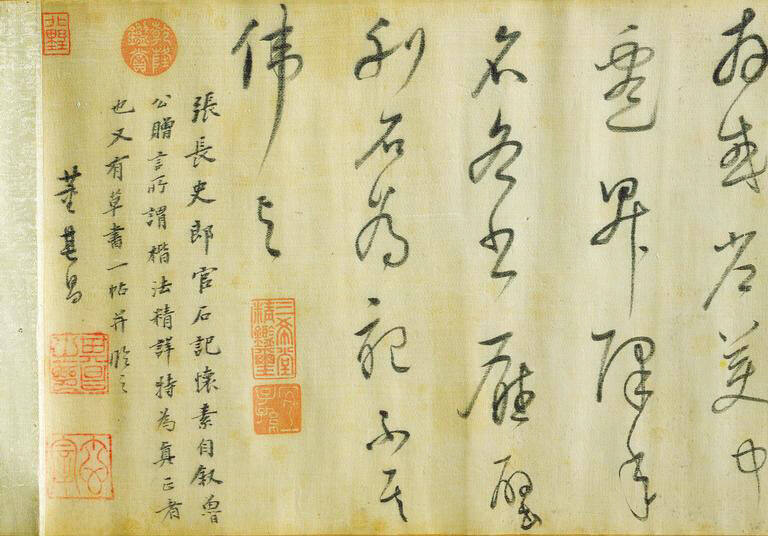

张旭《郎官石记》的写意摹本
Medium墨缎
Dimensions10½X 129 ¼英寸(26.7×328.3厘米)
Credit Line创始人协会购买, 亨利福特二世基金
Object number77.63-simchi
ClassificationsCalligraphy
Curator Notes草书书法长卷,是唐朝草书大师张旭的一篇文章,其中包含艺术家印章,收藏章和玺印。
On View
Not on viewCollections
- Asian Art Department Highlights
Locations
- (not entered) Morgan Library & Museum (225 Madison Avenue at 36th Street), North Room
ProvenanceImperial Collection, Peking
Exhibitions
Terms
The history of Chinese calligraphy is as long as that of China itself. Calligraphy is one of the highest forms of Chinese art. In studying Chinese calligraphy one must learn something of the origins of Chinese language and of how they were originally written. However, except for those brought up in the artistic traditions of the country, its aesthetic significance seems to be very difficult to grasp.
Chinese calligraphy serves the purpose of conveying thought but also shows the 'abstract' beauty of the line. Rhythm, line, and structure are more perfectly embodied in calligraphy than in painting or sculpture.
Artistic Characters and rules:
Every Chinese character is built up in its own square with variety of structure and composition.
There are drawing of only three basic forms: the circle, the triangle, and the square.
For each character there is a definite number of strokes and appointed positions for them in relation to the whole. No stroke may be added or deleted for decorative effect.
Strict regularity is not required.
The pattern should have a living movement
Calligraphy is used in several areas of art produced in China. You will see it featured by itself in wall hangings on rice paper or silk. It is also used in paintings along with the picture and frequently in inside painted snuff bottles.
FOR DEMO ONLY
Chinese calligraphy serves the purpose of conveying thought but also shows the 'abstract' beauty of the line. Rhythm, line, and structure are more perfectly embodied in calligraphy than in painting or sculpture.
Artistic Characters and rules:
Every Chinese character is built up in its own square with variety of structure and composition.
There are drawing of only three basic forms: the circle, the triangle, and the square.
For each character there is a definite number of strokes and appointed positions for them in relation to the whole. No stroke may be added or deleted for decorative effect.
Strict regularity is not required.
The pattern should have a living movement
Calligraphy is used in several areas of art produced in China. You will see it featured by itself in wall hangings on rice paper or silk. It is also used in paintings along with the picture and frequently in inside painted snuff bottles.
FOR DEMO ONLY
There are no works to discover for this record.